

If you have ever walked out to your car on a sweltering Tampa morning only to hear that dreaded clicking sound when you turn the key, you already know the frustration of a dead battery. Most people assume cold weather is the enemy of car batteries, and while that is true to some extent, extreme heat is actually far more destructive to battery health over time. Tampa's year-round heat and humidity create conditions that can silently shorten your battery's lifespan before you ever see a warning sign.
At Lou's Total Car Care, we see battery-related issues constantly — especially during the hottest months of the year. The good news is that with a little knowledge and some proactive care, you can significantly extend the life of your battery and avoid getting stranded at the worst possible moment.
Why Heat Is a Battery's Worst Enemy
Your car battery works through a chemical reaction that generates electrical energy. The problem with heat is that it speeds up that chemical activity beyond what the battery is designed to handle consistently. In northern states, batteries often fail in winter because the cold slows down the chemical process. But here in Tampa, the damage happens in a different and often more sneaky way.
High temperatures cause the fluid inside your battery to evaporate faster than normal. This leads to internal corrosion on the battery's plates, which permanently degrades its ability to hold and deliver a charge. By the time your battery finally fails, the damage has often been building for months. You might notice it seems fine all summer, only to have it give out just when temperatures drop slightly in the fall — because the battery was already weakened and a minor change in conditions was enough to push it over the edge.
The Role of Humidity
Tampa's high humidity adds another layer of stress. Moisture in the air can accelerate corrosion on the battery terminals, which are the metal connectors that link your battery to the rest of your vehicle's electrical system. Corroded terminals cause poor connections, which means your alternator has to work harder to charge the battery, and your starter has to fight through resistance every time you start the car. Over time, this creates a cycle of electrical strain that wears down multiple components at once.
Heat Under the Hood
It is also important to remember that the temperature outside your car is not the only heat your battery faces. Engine compartment temperatures can easily reach 200 degrees or more during normal operation. In a vehicle that sits in direct sunlight on a Tampa summer afternoon, that heat builds even while the car is parked. Batteries positioned near the engine are particularly vulnerable, and without proper heat shielding or insulation, degradation happens faster than manufacturers typically account for in their standard lifespan estimates.
How to Tell If Your Battery Is Struggling
One of the most important skills a Tampa driver can develop is recognizing the early warning signs of a battery that is starting to fail. Catching these signs early gives you the opportunity to address the problem before it leaves you stranded or causes damage to other electrical components.
- Slow engine cranking: If your engine takes longer than usual to turn over when you start the car, your battery may not be delivering enough power to the starter.
- Dimming headlights or interior lights: Lights that seem less bright than normal, especially when the engine is idling, can indicate a battery that is struggling to hold a charge.
- Electrical accessories behaving oddly: Power windows that move slowly, a radio that resets itself, or a dashboard that flickers can all be signs of inconsistent power delivery from a weak battery.
- Swollen or bloated battery case: Heat can cause the battery case to expand. If your battery looks warped or misshapen, it should be replaced immediately.
- Rotten egg or sulfur smell: This odor can indicate that the battery is leaking or overheating internally, which is a serious safety concern.
- Frequent need to jump start: If you have needed a jump start more than once in a short period, your battery is not holding a charge properly.
- Battery warning light on your dashboard: This light can indicate a problem with the battery itself, the alternator, or the charging system in general.
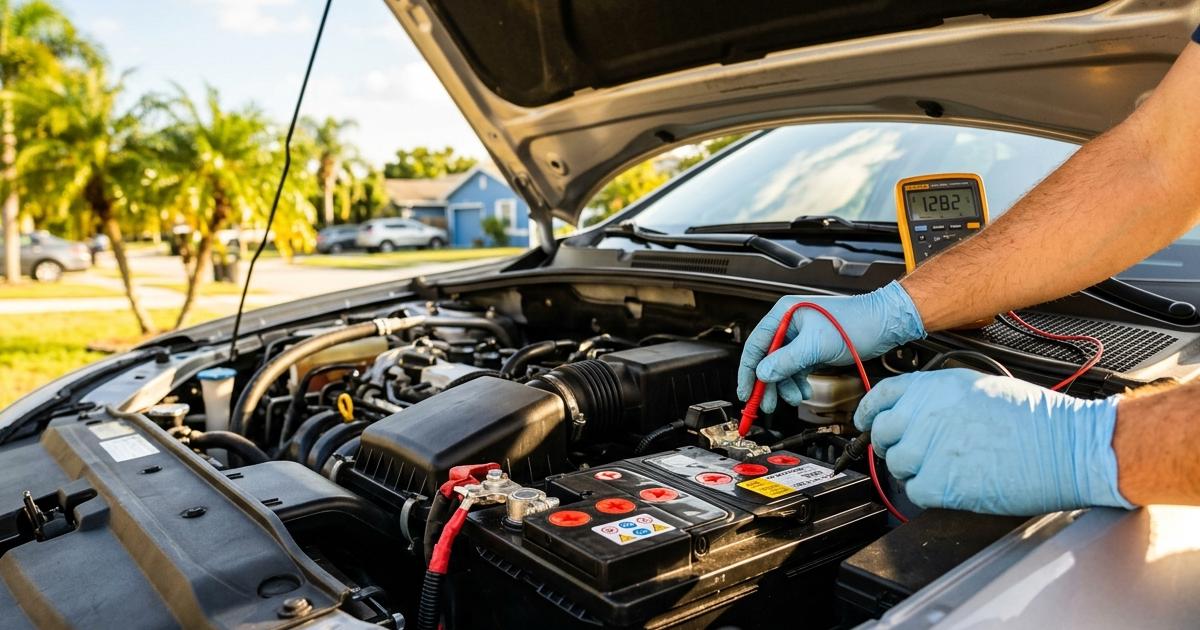
It is worth noting that a battery can pass a standard voltage test and still be in poor condition. A proper load test, which checks how the battery performs under the electrical demands of starting and running your vehicle, gives a much more accurate picture of battery health. At Lou's Total Car Care, we perform thorough battery testing to give you a complete and honest assessment.
Practical Steps to Extend Your Battery's Life in Tampa's Climate
While you cannot change the weather, there are several smart habits and maintenance practices that can meaningfully extend your battery's lifespan in a hot climate like Tampa's.
Park in the Shade Whenever Possible
This sounds simple, but it makes a real difference. Parking in a garage, under a carport, or even in a shaded area of a parking lot reduces the amount of heat your battery is exposed to when the car is not running. Every degree of temperature reduction takes stress off the battery and the rest of your vehicle's components.
Keep Your Terminals Clean
Corrosion on battery terminals is common in Florida's humid environment. A buildup of white or blue-green residue on the terminals should be cleaned off regularly. In many cases, a mixture of baking soda and water can neutralize corrosion, but if buildup is severe, it is best to have a professional clean and inspect the connection points. Tight, clean terminal connections ensure that your battery can deliver power efficiently without unnecessary strain on the charging system.
Have Your Battery Tested Regularly
Most auto repair professionals recommend having your battery tested at least once a year in hot climates, and more frequently if your vehicle is older or if you have noticed any of the warning signs mentioned above. A quick battery test takes only a few minutes and can give you peace of mind or alert you to a problem before it becomes an emergency. At Lou's Total Car Care, battery testing is part of our routine maintenance approach, and we will always give you a straightforward answer about whether your battery is healthy or nearing the end of its life.
Do Not Ignore Short Trips
Your battery recharges while the engine is running, primarily through the alternator. If you regularly take very short trips around Tampa — a few minutes here and there — the battery may never fully recharge between uses. Over time, repeatedly running on a partial charge degrades battery capacity. If short trips are unavoidable, consider taking a longer drive once or twice a week to give the charging system time to do its job properly.
Replace Your Battery Proactively
In cooler climates, a car battery might last five to seven years. In Tampa's heat, a realistic lifespan is often closer to three to four years, sometimes less depending on driving habits and the quality of the battery. Rather than waiting for a failure, consider replacing your battery proactively when it approaches the three-year mark or when testing indicates it is holding less than 80 percent of its rated capacity. The cost of a planned battery replacement is far less than the cost of an emergency tow and the inconvenience of being stranded.
Trust Lou's Total Car Care With Your Battery and Electrical System
Your battery does not work in isolation. It is part of a broader electrical system that includes your alternator, starter, and all of the wiring and fuses that power everything in your vehicle. When we inspect a battery at Lou's Total Car Care, we also look at the health of the charging system to make sure that a failing alternator is not draining a perfectly good battery, or that a corroded cable is not creating resistance that shortens your battery's life prematurely.
We service every make and model, and our team brings genuine experience and honest communication to every visit. We are not here to sell you parts you do not need — we are here to give you accurate information and reliable service so you can make the best decisions for your vehicle and your budget. If you are concerned about your battery or have noticed any of the warning signs described in this post, stop by our shop at 8317 Rustic Dr A in Tampa or give us a call at (813) 885-5687. We will test your battery, check your charging system, and give you a clear picture of where things stand — no pressure, no guesswork, just honest car care from a family-owned shop that genuinely cares about keeping Tampa drivers safe on the road.