
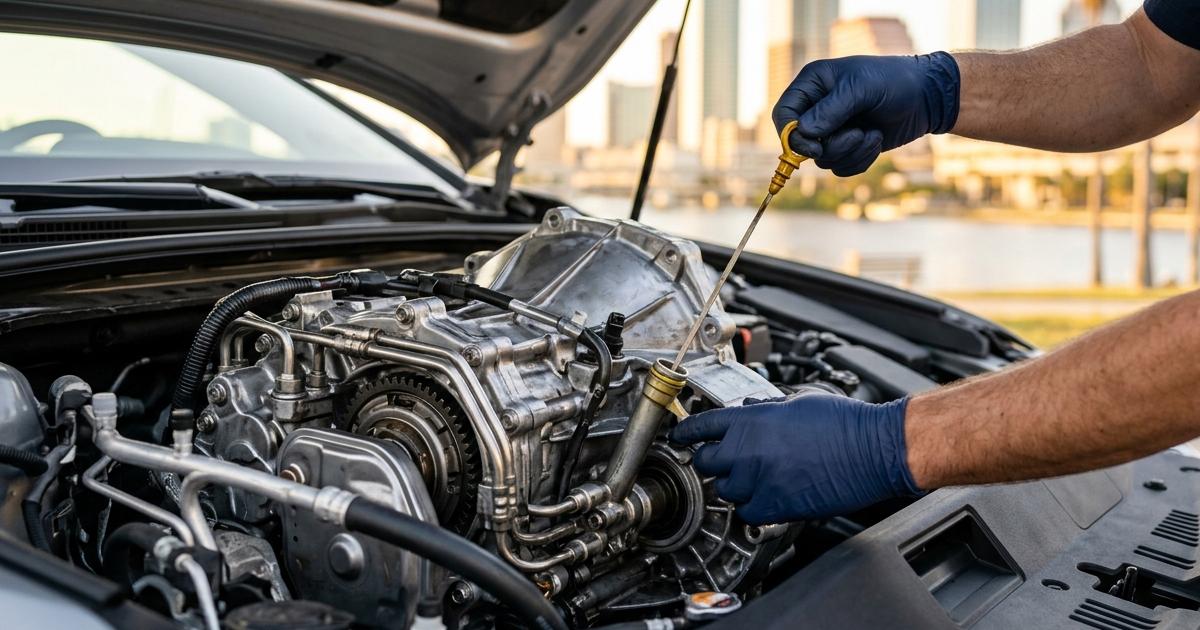

Your transmission is one of the most complex and critical components in your vehicle. It works quietly behind the scenes every time you drive, transferring power from your engine to your wheels and making sure everything shifts smoothly whether you are crawling through Tampa traffic on I-275 or cruising down Dale Mabry Highway. When it starts to fail, the consequences can be expensive — and dangerous. The good news is that transmissions rarely fail without warning. Knowing what to look and listen for can save you thousands of dollars and keep you safe on the road.
At Lou's Total Car Care in Tampa, we see transmission problems at every stage — from the very early warning signs that are easy to miss, all the way to complete failures that leave drivers stranded. Understanding the red flags early is always the better path, and that is exactly what this guide is designed to help you do.
Why Transmissions Fail in the First Place
Before diving into the warning signs, it helps to understand why transmissions break down. In most cases, transmission failure is not a sudden event. It builds over time due to a combination of factors that are often entirely preventable with routine maintenance.
Heat Is the Number One Enemy
Here in Tampa, heat is a constant reality. High ambient temperatures combined with the stop-and-go traffic that is a daily part of life in this city creates the perfect conditions for transmission fluid to break down faster than it would in cooler climates. Transmission fluid lubricates internal components, cools the system, and maintains hydraulic pressure. When that fluid degrades or gets too low, metal parts start grinding against each other and heat builds rapidly. Over time, this causes serious internal damage.
Neglected Fluid Changes
Many drivers are surprised to learn that transmission fluid needs to be changed at regular intervals just like engine oil. When fluid changes are skipped or delayed, old and contaminated fluid circulates through the system and accelerates wear. At Lou's Total Car Care, fluid checks and changes are part of our routine maintenance approach, because we know how much damage neglect can cause over time in Florida's demanding climate.
Warning Signs Your Transmission May Be Failing
Catching transmission trouble early is everything. Here are the most important warning signs to watch for, whether you drive an automatic or a manual transmission vehicle.
Slipping Gears
One of the most common and alarming symptoms is gear slipping. This is when your vehicle unexpectedly changes gears on its own, or the engine revs higher than it should without a corresponding increase in speed. In an automatic transmission, this can feel like the car is hesitating or lunging unpredictably. In a manual, it may feel like the gear pops out while you are driving. Slipping is a serious safety issue and should never be ignored.
Delayed or Rough Shifting
Does your car hesitate before engaging gear when you shift from park to drive? Does it clunk, jerk, or shudder when shifting between gears? These are classic signs that something is wrong inside the transmission. Smooth, seamless shifting should be the norm. Anything that feels rough, delayed, or accompanied by a thud warrants a professional inspection right away.
Unusual Noises
A healthy transmission operates quietly. If you start hearing whining, humming, clunking, or buzzing sounds while driving or when shifting, pay attention. These noises can point to worn bearings, low fluid levels, or damaged internal components. The sounds may be subtle at first and gradually get worse over time, which is why early attention matters so much.
Transmission Fluid Leaks
Transmission fluid is typically bright red or dark red with a slightly sweet smell. If you notice a reddish puddle beneath your vehicle — particularly toward the center or front — you likely have a transmission fluid leak. Running your transmission low on fluid is one of the fastest ways to cause irreversible damage. If you see any fluid beneath your car, bring it in to be checked before you drive it further.
Warning Lights on the Dashboard
Modern vehicles are equipped with sensors throughout the transmission system. If something is off, your vehicle may trigger the check engine light or a dedicated transmission warning light. While a warning light alone does not confirm transmission failure, it is always a signal that diagnostics are needed. At Lou's Total Car Care, our team uses advanced diagnostic tools to read fault codes and identify exactly what is happening inside your vehicle.
Burning Smell
A burning odor coming from your vehicle — especially while driving or after a long stop-and-go commute — can indicate overheating transmission fluid. This is a serious warning sign. Overheated fluid breaks down rapidly and loses its ability to protect internal components. If you smell something burning, it is time to get your vehicle inspected immediately.
What Transmission Problems Look Like at Every Stage
Transmission issues tend to progress in stages. Catching a problem in the early stage is significantly less costly than waiting until it reaches the later stages. Here is a general breakdown of how transmission failure typically progresses:
- Early Stage: Subtle hesitation when shifting, occasional slipping, slightly rough gear changes that you might dismiss as normal. Fluid may be low or starting to degrade. This is the ideal time to bring your vehicle in — repairs at this stage are typically minor and affordable.
- Middle Stage: Slipping becomes more frequent, shifting feels noticeably rough or delayed, warning lights may appear, and you may hear unusual noises. Internal wear is underway and the situation will not improve without professional attention.
- Late Stage: The transmission is struggling to function. Gear engagement may fail entirely, grinding or banging noises become pronounced, and the vehicle may become difficult or unsafe to drive. Repairs at this stage can range from a major overhaul to a full transmission replacement.
- Failure: The transmission stops working altogether. The vehicle may not move or may be stuck in one gear. This is the most expensive outcome and is almost always avoidable with earlier intervention.
How Lou's Total Car Care Approaches Transmission Diagnosis and Repair
At Lou's Total Car Care, we believe in honest assessments and straightforward communication. When you bring your vehicle to us with transmission concerns, we start with a thorough diagnostic process. Our technicians use professional-grade diagnostic equipment to read fault codes and assess the condition of your transmission fluid, linkage, seals, and internal components.
We work on every make and model, and we handle everything from fluid flushes and filter changes to more involved transmission repairs. Our goal is always to give you an honest picture of what is going on and present you with options that make sense for your vehicle and your budget. We never recommend unnecessary repairs, and we always explain what we find in plain language before any work begins.
Because we are a family-owned shop right here in Tampa, our reputation is built on the trust of our community. That means we treat every vehicle — and every customer — the way we would want to be treated ourselves.
Do Not Wait Until It Gets Worse
Transmission problems have a way of compounding quickly. What starts as a minor fluid issue or a small seal leak can turn into thousands of dollars in damage if left unaddressed. Tampa's heat and traffic conditions only accelerate that timeline. If your vehicle is showing any of the warning signs described in this guide, the smartest move you can make is to get it looked at sooner rather than later.
Lou's Total Car Care is located at 8317 Rustic Dr A, Tampa, FL 33634. Give us a call at (813) 885-5687 to schedule an appointment or to talk through what you are experiencing with your vehicle. We are here to help, and we will always give you straight answers you can trust.